
Restaurant Food Cost Calculator: How to Price Menu Items Profitably
Table of ContentsTap to expand
Are your restaurant menu prices actually profitable?
A dish might sell 100 times a day, but that doesn't necessarily mean your restaurant is making good money from it. If ingredient prices increase, portions become inconsistent, or food gets wasted, your profit can disappear without you noticing.
For example, imagine selling a chicken biryani for Rs. 450. It costs Rs. 150 to prepare, so your food cost is 33.3%. But if you don't account for packaging, discounts, delivery commissions, staff expenses, and other operating costs, you may be overestimating your actual profit.
This is why every restaurant needs to calculate food costs before setting menu prices. A restaurant food cost calculator helps you understand how much each dish costs to prepare, what percentage of its selling price goes toward ingredients, and what price you should charge to reach your target food cost percentage.
In this guide, you'll learn how to calculate food costs, price menu items, identify unprofitable dishes, and manage restaurant costs more effectively — with practical examples using Pakistani Rupees (PKR).

Quick Answer: What Is the Restaurant Food Cost Formula?
Restaurant food cost percentage is calculated using the standard formula:
To calculate your recommended menu price from a target food cost percentage:
For example, if a serving costs Rs. 155 to prepare and you target a 30% food cost (0.30): Rs. 155 ÷ 0.30 = Rs. 517 suggested starting price.
What Is Restaurant Food Cost?
Restaurant food cost is the total amount a restaurant spends on ingredients used to prepare its food. It includes:
- Meat, chicken, mutton, beef, fish, and seafood
- Vegetables and fruits
- Rice, flour, dairy, and other raw pantry materials
- Cooking oil, ghee, and spices
- Sauces, toppings, and garnishes
- Other consumable ingredients used in preparation
Food cost is usually measured as a percentage of food sales.
For example, if preparing a burger costs Rs. 180 and you sell it for Rs. 600, your food cost percentage is 30%.
This means 30% of the selling price goes toward ingredients. The remaining 70% is not pure profit. It must also cover labor, rent, electricity, gas, packaging, marketing, delivery commissions, and other operating expenses.
Restaurant Food Cost Calculator: Calculate Your Menu Prices
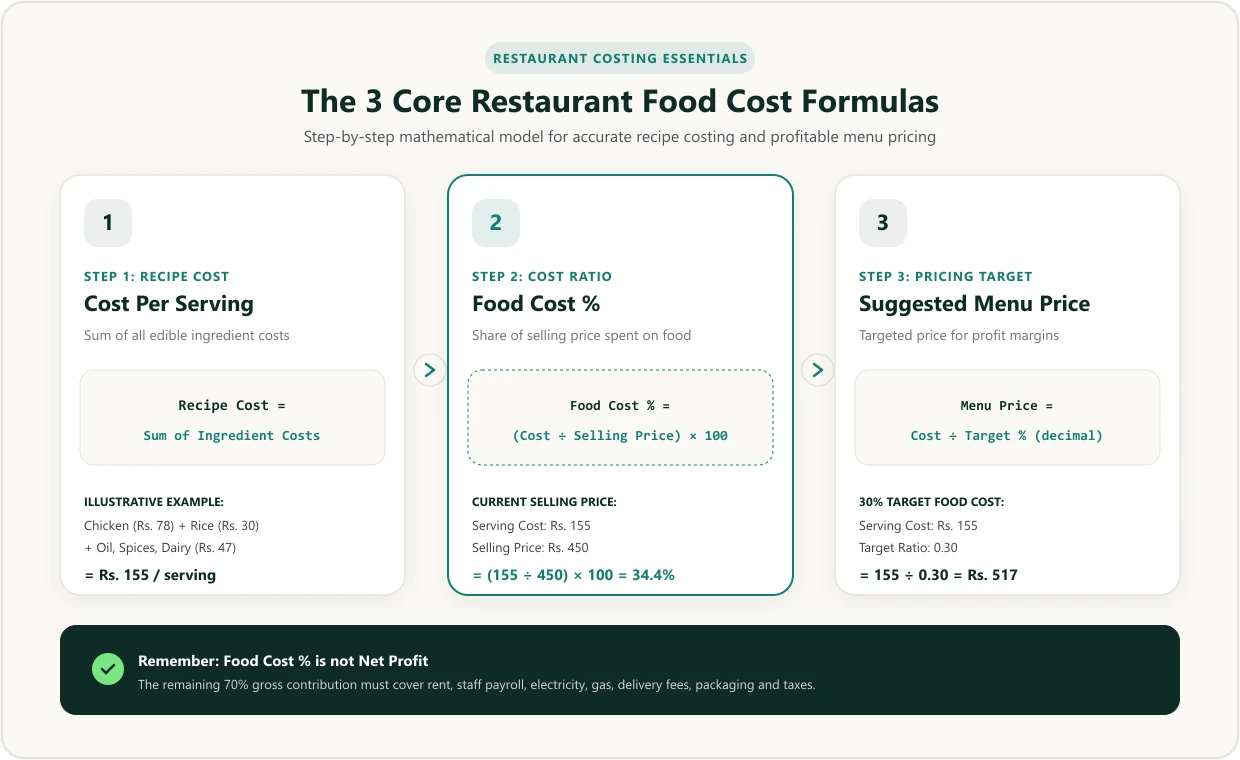
Before pricing your menu, calculate the actual cost of preparing one serving. Use these three core formulas:
Recipe Cost
Recipe Cost = Sum of all individual ingredient costs in the portion
Food Cost Percentage
Food Cost % = (Cost Per Serving ÷ Menu Selling Price) × 100
Recommended Menu Price
Menu Price = Cost Per Serving ÷ Target Food Cost Percentage (as decimal)
For the third formula, convert the percentage into a decimal. For example, 30% = 0.30; 28% = 0.28; 35% = 0.35.
Example: Calculate the Food Cost of Chicken Biryani
Suppose your restaurant prepares a single plate of chicken biryani using the following ingredients:
| Ingredient | Quantity | Cost (PKR) |
|---|---|---|
| Rice | 150 g | Rs. 30 |
| Chicken | 120 g | Rs. 78 |
| Cooking oil | 20 ml | Rs. 12 |
| Yogurt | 30 g | Rs. 9 |
| Onions | 40 g | Rs. 8 |
| Tomatoes | 30 g | Rs. 6 |
| Spices and other ingredients | — | Rs. 12 |
| Total Ingredient Cost | 1 Serving | Rs. 155 |
The total ingredient cost for one serving is Rs. 155.
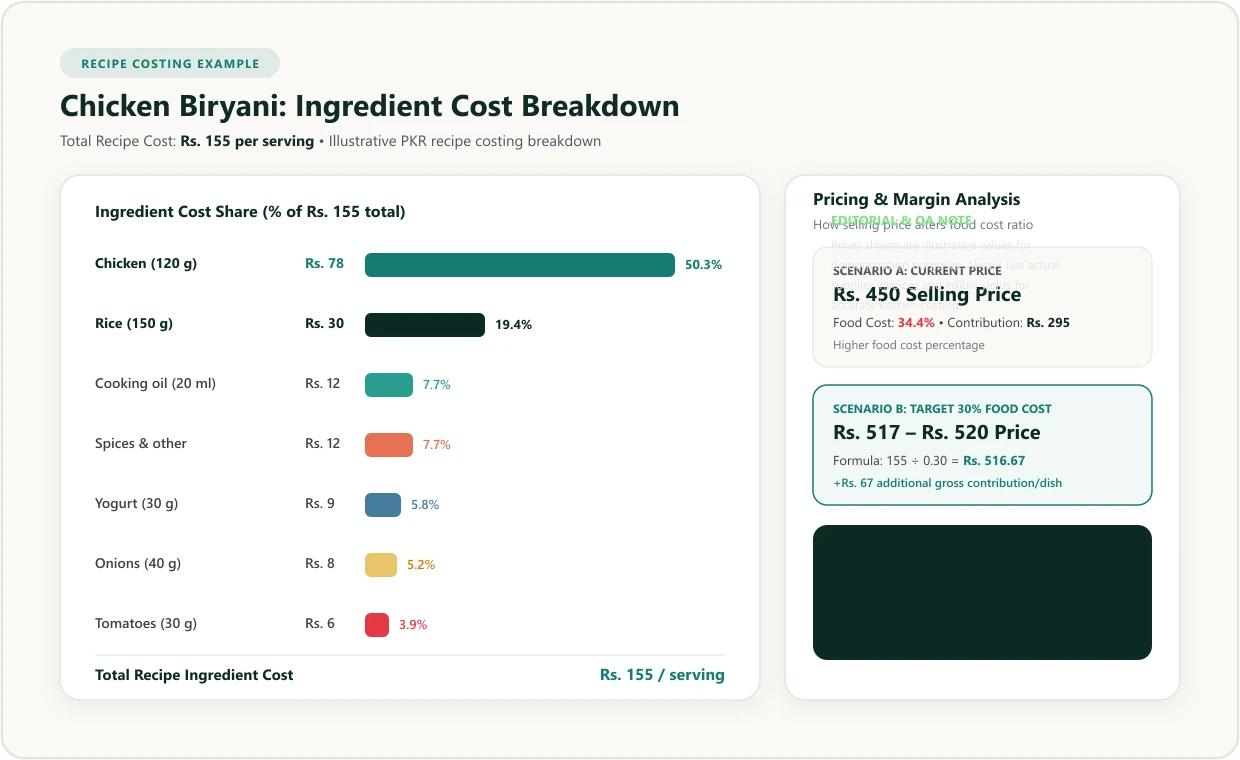
Now assume you sell this biryani for Rs. 450.
Food Cost Percentage:
Your biryani has a food cost percentage of approximately 34.4%.
What If You Want a 30% Food Cost?
Use the menu pricing formula with 0.30:
Your calculated starting menu price should be approximately Rs. 517. You could test a selling price of Rs. 520, provided it makes sense for your customers and local market positioning.
Interactive Restaurant Food Cost Calculator
Test your own recipes below. Enter your total recipe ingredient cost, your current selling price, and your target food cost percentage to instantly calculate your margins:
How to Calculate Restaurant Food Cost Step by Step
Follow these six steps to calculate the food cost of any restaurant menu item accurately:
Step 1: List Every Single Ingredient
Write down everything required to prepare one dish — don't calculate only the expensive protein. For example, a gourmet burger contains far more than just minced beef:
- Burger bun (artisan or brioche)
- Chicken or beef patty
- Processed or cheddar cheese slice
- Mayonnaise and custom burger sauce
- Lettuce, sliced tomato, pickles, and onion
- Cooking oil or butter on the grill
- Seasoning, salt, pepper, and marinade spices
Small ingredients — sauces, cooking oil, spices, and garnishes — look trivial in isolation, but when you sell hundreds of portions a day, uncounted condiments quickly bleed profits.
Step 2: Calculate the Purchase Cost Per Unit
Find the cost of each ingredient based on its bulk purchase invoice:
Example: You purchase a 5 kg pack of chicken breast for Rs. 3,000.
• Cost per kilogram: Rs. 3,000 ÷ 5 kg = Rs. 600/kg
• Cost per gram: Rs. 600 ÷ 1,000 g = Rs. 0.60/g
• If your recipe portion uses 150 grams: 150 g × Rs. 0.60 = Rs. 90.00
Your chicken cost per serving is Rs. 90.
Step 3: Include Preparation Waste and Edible Yield
Not every gram you purchase ends up on a customer's plate. Real-world restaurant kitchens lose ingredients through:
- Vegetable peeling, de-seeding, and coring
- Meat trimming (fat, skin, tendons, and bones)
- Moisture evaporation and shrinkage during cooking
- Prep-line spillage and workstation waste
- Spoiled or oxidized raw goods
For example, if you purchase 1 kg (1,000 g) of raw vegetables but after peeling and trimming only 900 grams are usable, your edible yield is 90%:
Ingredient Cost Per Usable Gram = Purchase Cost ÷ Usable Quantity in Grams
Factor in prep waste to avoid underestimating your true cost of goods sold. (Be careful not to count waste twice if your standardized recipe cards already specify edible portion weights rather than raw purchase weights).
Step 4: Calculate the Total Cost Per Serving
Add the costs of all edible ingredients used in the recipe. For batch recipes (such as a 20-liter pot of soup, curry gravy, or biryani daig):
For example, if a batch of special house sauce costs Rs. 4,000 to prepare and yields 20 standard restaurant containers: Rs. 4,000 ÷ 20 = Rs. 200 per serving.
Step 5: Set Your Selling Price Based on Target Margins
Choose a target food cost percentage aligned with your restaurant model. Suppose your serving cost is Rs. 200 and your target food cost is 30%:
You can test a consumer-friendly menu price of Rs. 670 or Rs. 690.
Step 6: Review Your Menu Prices Regularly
Ingredient costs change constantly. Cooking oil, poultry, dairy, produce, and imported seasonings fluctuate with market inflation. If your recipe cost climbs from Rs. 155 to Rs. 190 but your selling price stays fixed at Rs. 450, your food cost jumps from 34.4% to 42.2% — quietly consuming your profits.
Review ingredient costs and recipe profitability at least monthly, rather than relying on figures calculated six months ago.
What Is a Good Food Cost Percentage for a Restaurant?
There is no universal food cost percentage that guarantees profitability. Your ideal target depends on your restaurant type, ingredient profile, labor costs, location rent, and service model.
A commonly used planning range across the food service industry is approximately 28% to 35%, but this is a starting benchmark, not a rigid rule:
| Restaurant Type | Typical Food Cost Planning Target | Cost Driver Nuance |
|---|---|---|
| Fast food / QSR | 25%–35% | High volume, standardized portions, lower labor per order |
| Casual dining | 28%–35% | Balanced ingredient mix with table service labor |
| Fine dining | 30%–40% | Premium seafood, aged beef, specialized culinary technique |
| Café & Coffee Shop | 20%–30% | High markup on espresso drinks, lower food spoilage |
| Bakery | 25%–35% | Flour, sugar, butter batch economy with daily shelf life considerations |
| Pizza restaurant | 25%–35% | Low-cost dough base offset by cheese and premium meats |
These ranges are planning benchmarks, not guaranteed industry averages. For example, a restaurant selling premium imported seafood may have a 38% food cost percentage, but because the selling price is Rs. 3,500, every sale generates Rs. 2,170 in gross contribution toward expenses. Conversely, a café selling coffee at an 18% food cost generates Rs. 350 per cup.
The critical metric is how much cash each dish contributes toward paying your rent, staff, utilities, and owner profit.
Food Cost Percentage vs. Profit Margin: What's the Difference?
Restaurant owners frequently confuse food cost percentage with profit margin. They are not the same thing.
Let's compare them directly:
Suppose you sell a large specialty pizza for Rs. 1,000:
• Ingredient cost: Rs. 300
• Selling price: Rs. 1,000
• Food Cost Percentage: (Rs. 300 ÷ Rs. 1,000) × 100 = 30.0%
• Gross Contribution After Ingredients: Rs. 1,000 − Rs. 300 = Rs. 700
That Rs. 700 is your gross contribution margin — not your final net profit. From that Rs. 700, your restaurant must still pay for:
- Chef, kitchen staff, and server salaries
- Dining hall and kitchen rent
- Commercial gas and electricity bills
- Takeaway packaging, pizza boxes, and disposable cutlery
- Delivery platform aggregator commissions (often 18% to 25%)
- POS hardware and payment processing card fees
- Marketing, social media ads, and customer promotions
- Sales tax (FBR / PRA / SRB) and licensing fees
Remember:
Food cost percentage only measures raw ingredient expenses relative to sales. It does not tell you how much net profit remains in your bank account after all business overheads are settled.
How to Price Restaurant Menu Items Profitably (5 Factors)
Calculating food cost is only the first step of menu pricing. To make sustainable pricing decisions, evaluate these five strategic factors:
1. Calculate the Actual Recipe Cost
Never set menu prices based only on what competitors charge or personal intuition. Calculate the cost of every ingredient, including sauces, cheese slices, cooking oil, and garnishes. Reliable recipe costing gives you an objective foundation.
2. Consider Total Operating Expenses
A restaurant needs to pay far more than grocery bills. Separate your fixed monthly expenses (rent, salaried employees, software subscriptions, equipment depreciation) and variable expenses (packaging, delivery aggregator fees, card processing, hourly labor) when determining your minimum required gross margin.
3. Benchmark Competitor Pricing Contextually
Research competing restaurants offering similar cuisine in your immediate delivery radius. Compare:
- Portion sizes and grammage
- Ingredient freshness and culinary quality
- Dine-in atmosphere and customer service
- Packaging presentation for delivery
- Brand perception and customer expectations
Your prices should be competitive without sacrificing your financial sustainability.
4. Understand Your Contribution Margin (Cash vs. Percentages)
Contribution margin tells you how many actual rupees remain from a sale after direct ingredient costs:
Consider this real-world comparison between two menu items:
| Menu Item | Selling Price | Ingredient Cost | Food Cost % | Cash Contribution |
|---|---|---|---|---|
| Chicken Burger | Rs. 500 | Rs. 150 | 30.0% (Lower %) | Rs. 350 |
| Beef Burger | Rs. 800 | Rs. 280 | 35.0% (Higher %) | Rs. 520 (+Rs. 170) |
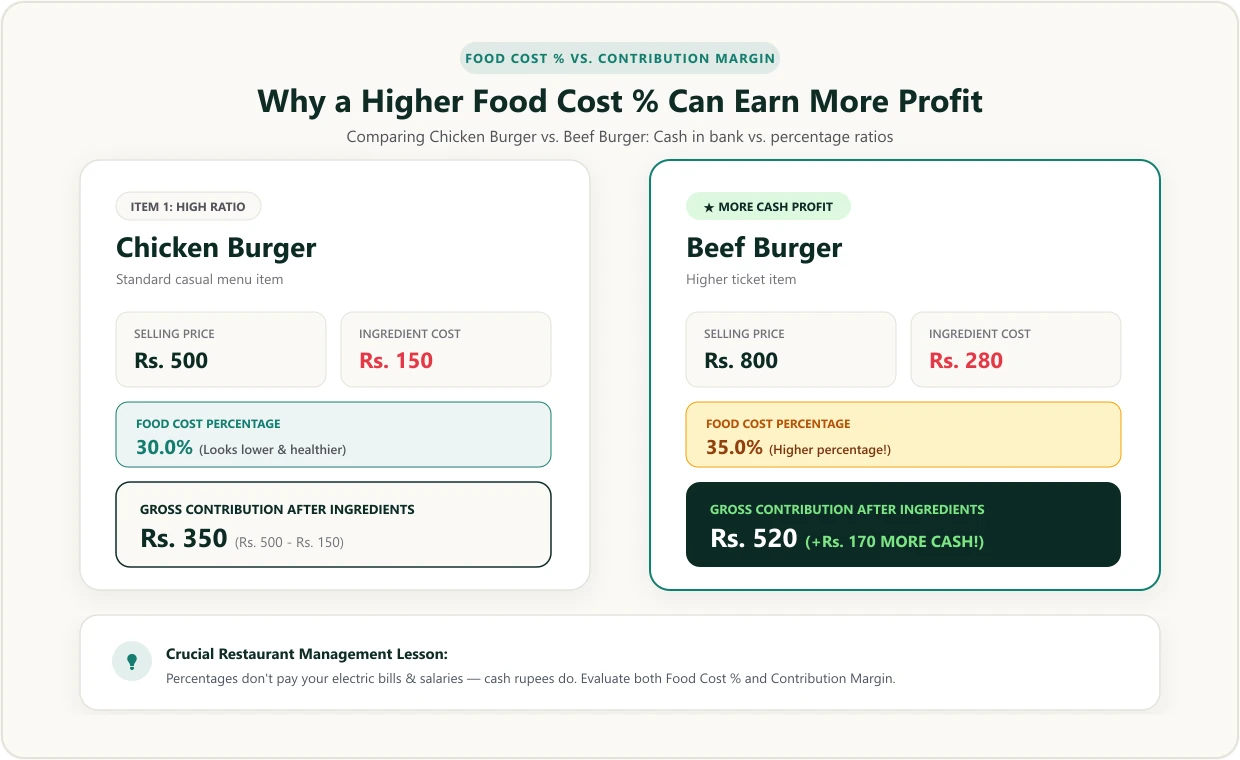
Notice: The beef burger has a higher food cost percentage (35% vs. 30%), which might look “worse” on a spreadsheet. However, it puts Rs. 170 more in cash into your bank account per order to pay for utilities, payroll, and profits. This is why experienced restaurateurs analyze both percentages and cash contribution margins.
5. Use Menu Engineering
Menu engineering is the practice of categorizing menu items according to their popularity (sales volume) and profitability (contribution margin):
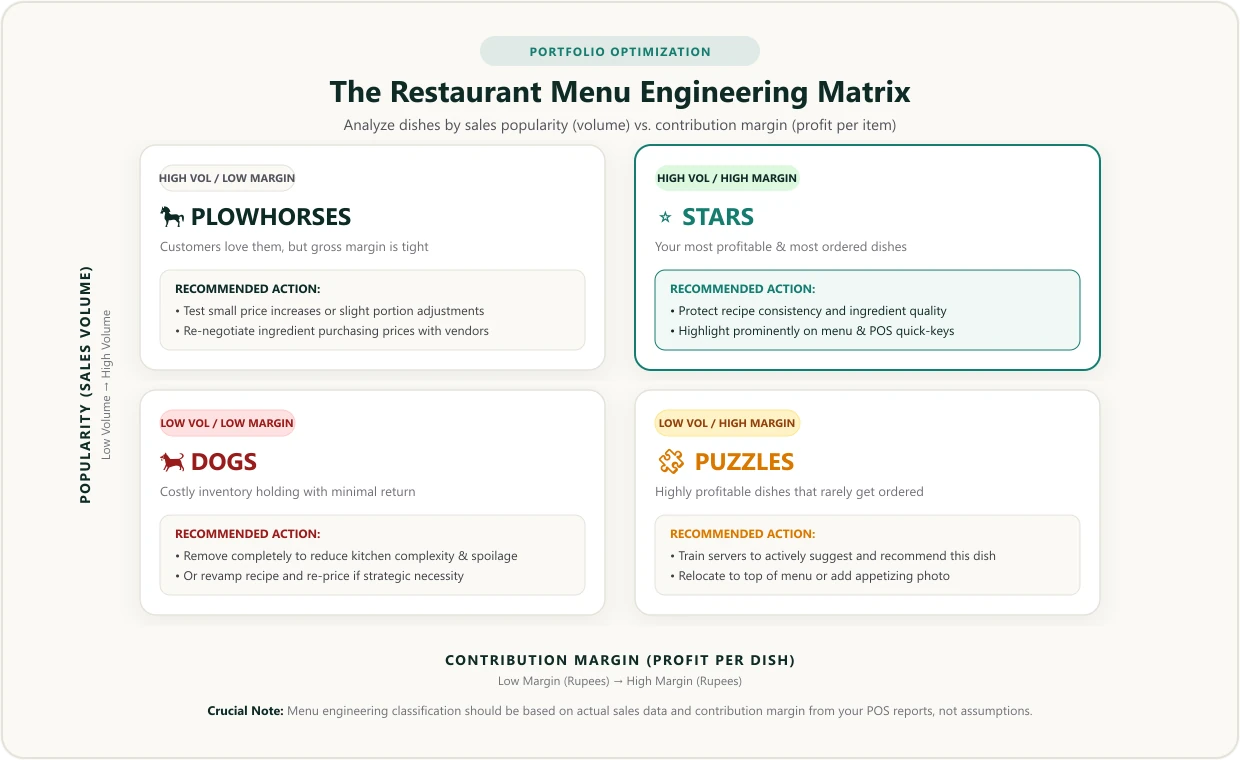
STARS (High Popularity, High Margin)
Dishes that customers order frequently and that generate substantial gross profit.
Action: Maintain strict recipe consistency, protect ingredient quality, and feature them prominently at the top of your menu.
PLOWHORSES (High Popularity, Low Margin)
Customer favorites that sell in high volume, but have high ingredient costs or lower selling prices.
Action: Review portion sizes, negotiate supplier bulk pricing, or test modest price increases of Rs. 20–50.
PUZZLES (Low Popularity, High Margin)
Highly profitable items that customers rarely notice or order.
Action: Improve food photography, rename the dish, reposition it in the menu focal zone, or train waitstaff to recommend it.
DOGS (Low Popularity, Low Margin)
Dishes that sell rarely and deliver little profit, tying up perishable inventory and kitchen prep time.
Action: Reformulate the recipe, replace with a higher-margin concept, or remove completely from the menu.
Always conduct menu engineering reviews using verified sales reporting from your restaurant POS software rather than guesses or gut feeling.
Actual Food Cost vs. Theoretical Food Cost
To identify kitchen cost leaks, compare theoretical food cost against actual food cost:
Theoretical Food Cost (What You Should Have Spent)
Theoretical food cost is what your restaurant should have spent on ingredients based on standard recipes multiplied by the exact number of dishes sold during a period:
Example: If your restaurant sold 100 burgers this week, and each burger requires Rs. 150 in ingredients:
100 burgers × Rs. 150 = Rs. 15,000 Theoretical Cost
Actual Food Cost (What You Actually Consumed)
Actual food cost measures the actual value of inventory consumed based on physical stock counts:
• Opening inventory at start of month: Rs. 50,000
• Invoiced supplier purchases during month: Rs. 100,000
• Closing physical inventory at end of month: Rs. 40,000
Actual Food Cost = Rs. 50,000 + Rs. 100,000 − Rs. 40,000 = Rs. 110,000
If your total food sales during the same month were Rs. 350,000, your Actual Food Cost Percentage is:
Investigating Food Cost Variance
When your actual food cost is significantly higher than your theoretical cost, the gap (cost variance) indicates hidden losses:
- Over-portioning: Cooks adding 180 grams of meat instead of the standardized 120 grams
- Unrecorded food waste: Burned batches, dropped plates, or expired stock thrown away without logging
- Unrecorded staff meals: Kitchen or front-of-house staff eating from inventory without ringing up staff discounts
- Supplier short-deliveries: Invoices billed for 20 kg when only 18 kg was delivered
- Shrinkage or pilferage: Stock unaccounted for in storage rooms
- Incorrect inventory counts: Counting errors or missing purchase invoice entries
7 Common Restaurant Food Cost Mistakes
Even busy restaurants with full dining rooms lose money because of avoidable costing errors. Watch out for these seven common mistakes:
1. Guessing Ingredient Costs
Estimating costs from memory rather than calculating them from current supplier invoices leads to inaccurate menu prices that fail to recover overhead.
2. Ignoring Small Ingredients & Condiments
Sauces, dips, cooking oil, specialty spices, cheese, and garnishes look cheap individually, but across 3,000 monthly orders they add up to tens of thousands of rupees.
3. Using Inconsistent Portion Sizes
If one kitchen employee adds 120 grams of chicken and another scoops 170 grams, your recipe cost becomes unpredictable. Standardize portion scoops, ladles, and scales.
4. Not Updating Menu Prices After Supplier Hikes
When poultry, dairy, or oil prices increase, your food cost percentage climbs automatically if your menu price remains unchanged.
5. Ignoring Kitchen Food Waste
Expired inventory, overproduction, incorrect orders, and improper storage drive up actual food costs. Keep a simple waste log near the prep station.
6. Confusing High Sales Volume With High Profit
High daily cash intake does not equal profit if your high-selling dishes carry an unsustainable 45% food cost and heavy delivery commission fees.
7. Managing Inventory Without Accurate Records
If supplier purchases, stock adjustments, and daily sales are not systematically recorded, calculating your actual food cost percentage becomes impossible.
How Restaurant POS Software Helps Control Food Costs
Calculating food costs on a spreadsheet works fine when you have a tiny 5-item menu. But as your restaurant grows — with dozens of menu dishes, ingredient substitutions, multiple suppliers, and hundreds of daily transactions — manual spreadsheet management becomes slow and error-prone.
A specialized restaurant POS system coordinates your daily front-of-house and back-of-house operations in real time:
- Accurate sales tracking: Record counter orders, dine-in tickets, and takeaway sales automatically.
- Menu & variant management: Organize menu categories, addon options, and item prices across branches.
- Supplier & purchase management: Track vendor bills, ingredient cost changes, and purchase histories in one place.
- Stock & inventory control: Maintain clear records of received stock and current inventory levels.
- Actionable reporting: Identify your best-selling menu items (Stars) and slow movers (Dogs) instantly.
- Centralized operations: Monitor sales and register transactions without waiting for manual paper reports.
Note: A POS system does not automatically eliminate kitchen waste on its own — standardized kitchen prep, portion discipline, and accurate system configuration remain essential.
Manage Your Restaurant Operations With HulmPOS
If you manage a restaurant, café, pizza parlour, burger joint, or food truck, you need more than a simple billing machine.
You need a modern, cloud-based platform that helps you understand daily sales, organize inventory, record purchases, and track profitability across your operations.
HulmPOS is an intuitive, cloud-based POS and restaurant management solution designed specifically for food businesses.
Key Features of HulmPOS for Restaurants:
- Order & table management: Coordinate dine-in tables, table merging, and live status.
- Flexible payment handling: Accept cash, card, mixed split-tenders, and digital payments.
- Product & stock management: Track inventory, menu items, prices, and categories.
- Purchases & vendor records: Log supplier invoices to monitor ingredient inflation.
- Real-time business reports: Access daily sales, top-selling items, and shift summaries from your laptop or phone.
- Hardware compatibility: Connect thermal receipt printers, barcode scanners, and cash drawers.
HulmPOS subscriptions start at just PKR 2,500/month, making professional restaurant management accessible for independent food businesses and growing multi-branch brands alike.
Frequently Asked Questions
Formula:
Food Cost % = (Ingredient Cost ÷ Selling Price) × 100
For example, a dish costing Rs. 200 to prepare and selling for Rs. 600 has a food cost percentage of 33.33%.
For example, if your portion costs Rs. 180 and your target food cost is 30% (0.30):
Rs. 180 ÷ 0.30 = Rs. 600
Your starting baseline menu price should be Rs. 600.
Final Thoughts: Smarter Menu Decisions & Cost Control
Profitable restaurant pricing starts with understanding what each dish actually costs to produce. A restaurant food cost calculator helps you calculate ingredient costs, monitor your food cost percentages, and establish a realistic baseline menu price.
However, sustainable restaurant profitability requires looking beyond a single formula. You must also balance cash contribution margins, customer price tolerance, competitor benchmarks, portion consistency, kitchen waste reduction, and operating overheads.
Make recipe costing a permanent habit in your restaurant operations. Audit your numbers regularly, adjust menu prices when wholesale ingredient costs rise, and leverage connected POS software to make informed, data-driven decisions.
To organize your restaurant orders, tables, sales, inventory, and supplier transactions in one intuitive platform, explore HulmPOS for Restaurants or visit hulmsolutions.com.
Better Cost Tracking. Smarter Menu Decisions.
Take control of your restaurant margins. Start your 14-day free trial with HulmPOS today — subscriptions starting at PKR 2,500/month.
Upgrade Your Business with Hulm POS
Designed for speed, simplicity, and multi-location scalability. Start ringing up sales in minutes.
Start Your Free Trial
 WhatsApp